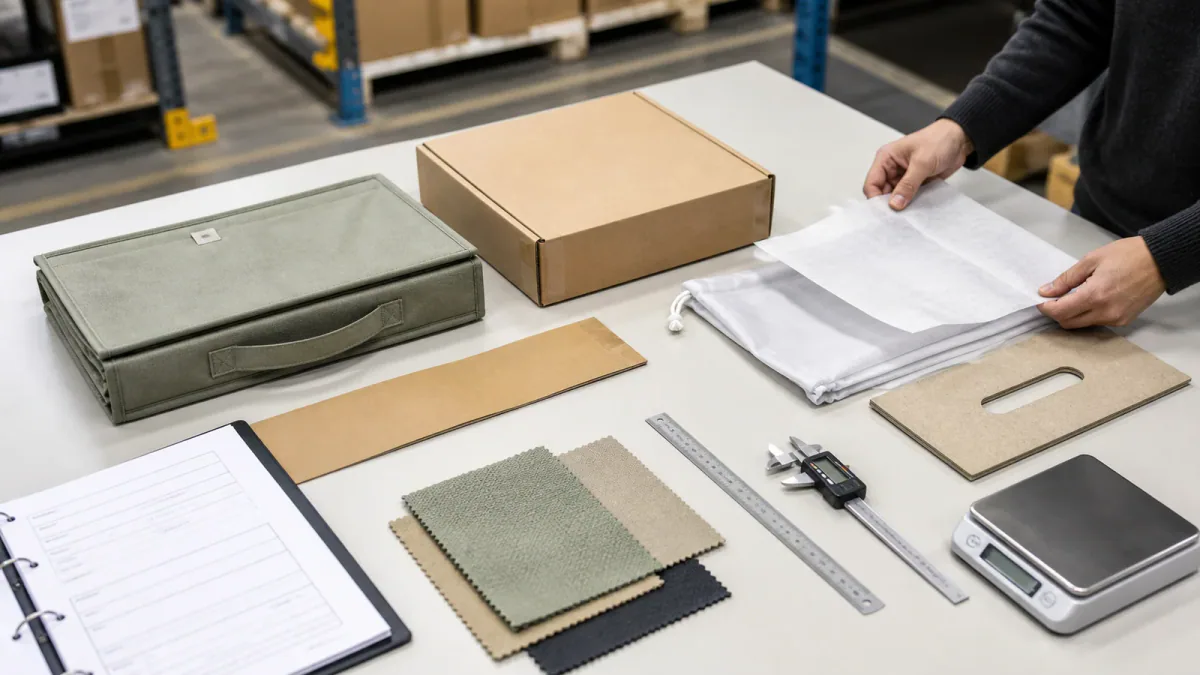
A manufacturing-side guide for brands, buyers and retailers turning an idea into clear, verifiable product requirements.
The EU Packaging and Packaging Waste Regulation (PPWR) generally applies from 12 August 2026. For importers, brands, retailers and sourcing managers buying fabric-storage goods, this does not mean every future target becomes mandatory on the same day. It means building an auditable chain from packaging classification and supply-chain roles to the requirements that apply now.
What starts applying today
The PPWR covers packaging of all materials placed on the EU market and distinguishes sales, grouped, transport and e-commerce packaging. Before placing packaging on the market, a manufacturer must assess it against the requirements in Articles 5 to 12 that are currently applicable, prepare the Annex VII technical documentation and draw up an EU declaration of conformity. An importer must verify that the manufacturer has completed the assessment and relevant documentation and identification steps. Economic operators also have traceability duties concerning identities and supply-chain transactions.
The phrase currently applicable matters. Article 6 establishes the recyclability framework, but Commission guidance explains that conformity assessment under PPWR Article 38 is not carried out for recyclability until the delegated act under Article 6(4) is in place; the earlier Packaging Directive and applicable standards remain relevant during the transition. A purchase specification should therefore separate immediate documentation duties from later performance thresholds instead of claiming that every PPWR metric took effect today.
When a fabric-storage item is a product or packaging
A folding storage cube, garment organiser or drawer divider sold as a durable item is generally first a product; it does not automatically become packaging merely because it is textile and can hold something. A textile pouch, cover or dust bag may be sales packaging when its intended function is to contain, protect, handle, deliver or present another product. Commission guidance also makes clear that textile sales packaging is excluded from the Article 6 recyclability requirement, not from the entire PPWR.
One project may still include a plastic inner bag, paper sleeve, hangtag, carton, pallet, cushioning and courier mailer. Each layer should be classified by its real function and route to market. Ordinary transport packaging has an exception from parts of the labelling regime, but e-commerce packaging does not automatically share that exception. Buyers should map the packaging hierarchy before deciding which evidence belongs to each layer.
Records and responsibilities buyers should establish now
A sourcing pack should record, for every packaging layer, its material, basis weight or weight, dimensions, components, coatings, inks, adhesives, closure and void fill, plus whether it serves stores, warehousing, cross-border transport or direct-to-consumer fulfilment. A supplier can provide material and construction data, but the EU importer, brand or commissioning party must still determine whether it acts as manufacturer, importer, distributor or producer in the transaction concerned.
Manufacturer and producer are different PPWR roles. A manufacturer is responsible for packaging design, manufacture and conformity, while producer status commonly relates to first making packaging or packaged products available in a Member State and to extended producer responsibility. Producer registration, reporting and fees must still be checked for each destination country and its transition rules. For imports, the date goods are released for free circulation can also matter; a contract or shipment date alone may not settle the applicable position.
In practice, buyers can organise evidence into three sets: packaging specifications and bill of materials; technical documentation, test basis and EU declaration of conformity; and operator identity, type or batch traceability and destination-country EPR records. Every test and declaration should identify the packaging version covered so that samples, mass production and e-commerce repacking do not drift apart.
Requirements that do not become mandatory today
The PPWR has a phased timetable. The duty to reduce empty space in sales packaging to the minimum necessary for packaging functionality applies from 12 February 2028. Harmonised material-composition labels generally apply from 12 August 2028 or 24 months after the relevant implementing act enters into force, whichever is later. Reusable-packaging labels generally apply from 12 February 2029 or 30 months after the implementing act enters into force, whichever is later.
Recyclability grades A, B and C generally become a market-access threshold from 1 January 2030 or 24 months after the relevant delegated acts enter into force, whichever is later. Plastic-packaging recycled-content targets generally apply from 1 January 2030 or three years after the relevant implementing act enters into force, whichever is later. The 50% empty-space cap for grouped, transport and e-commerce packaging generally applies from 1 January 2030 or three years after the relevant implementing act enters into force, whichever is later. Certain 2030 transport-packaging reuse targets have conditions and exemptions, and cardboard boxes are outside that specific reuse target; recycling-at-scale requirements point to 2035.
Later dates are not a reason to wait: redesign, retail testing and supplier verification can span several selling seasons. Equally, buyers should not turn a future threshold into a current legal warranty where its conditions are not yet applicable. The PPWR restriction on PFAS concerns food-contact packaging and should not be generalised to every fabric-storage pack. EPR must also be checked by Member State. This article provides procurement information, not legal advice.
How NHE can support a project and what to include in an enquiry
Within NHE’s confirmed fabric-storage OEM/ODM scope, NHE can help align product specifications, samples and packaging layers and compile supplier-available data on materials, dimensions, weights, construction and cartons. These data can serve as inputs for a buyer and its compliance adviser, but NHE does not replace the responsible EU operator in signing an EU declaration of conformity, determining all Member-State EPR duties or issuing legal certification.
An effective enquiry should include the target EU countries, brand or private-label relationship, retail or e-commerce channel, intended function of the textile item, every packaging layer, whether orders ship directly through e-commerce fulfilment, and any existing material and weight data. This makes it easier to identify classification, label-space, minimisation and documentation conflicts before sampling.
If you are planning a post-2026 EU fabric-storage programme, send NHE a packaging hierarchy diagram or current packaging list for an initial manufacturing-feasibility and data-gap discussion. The responsible EU operator and qualified advisers should confirm the final compliance position.
Editorial note: automation assisted the research and drafting process. Check original sources and destination-market requirements before making sourcing or compliance decisions.
Sources
These original sources support the industry facts, dates and figures referenced in this article.
- European Parliament and Council of the European UnionRegulation (EU) 2025/40 on packaging and packaging waste
- European CommissionCommission Notice — Guidance document for Regulation (EU) 2025/40 on packaging and packaging waste
- Netherlands Enterprise Agency (RVO)PPWR imposes stricter requirements on packaging
- Swedish Environmental Protection AgencyManufacturer, importer or distributor – what applies to you